Conformance Rule Packs
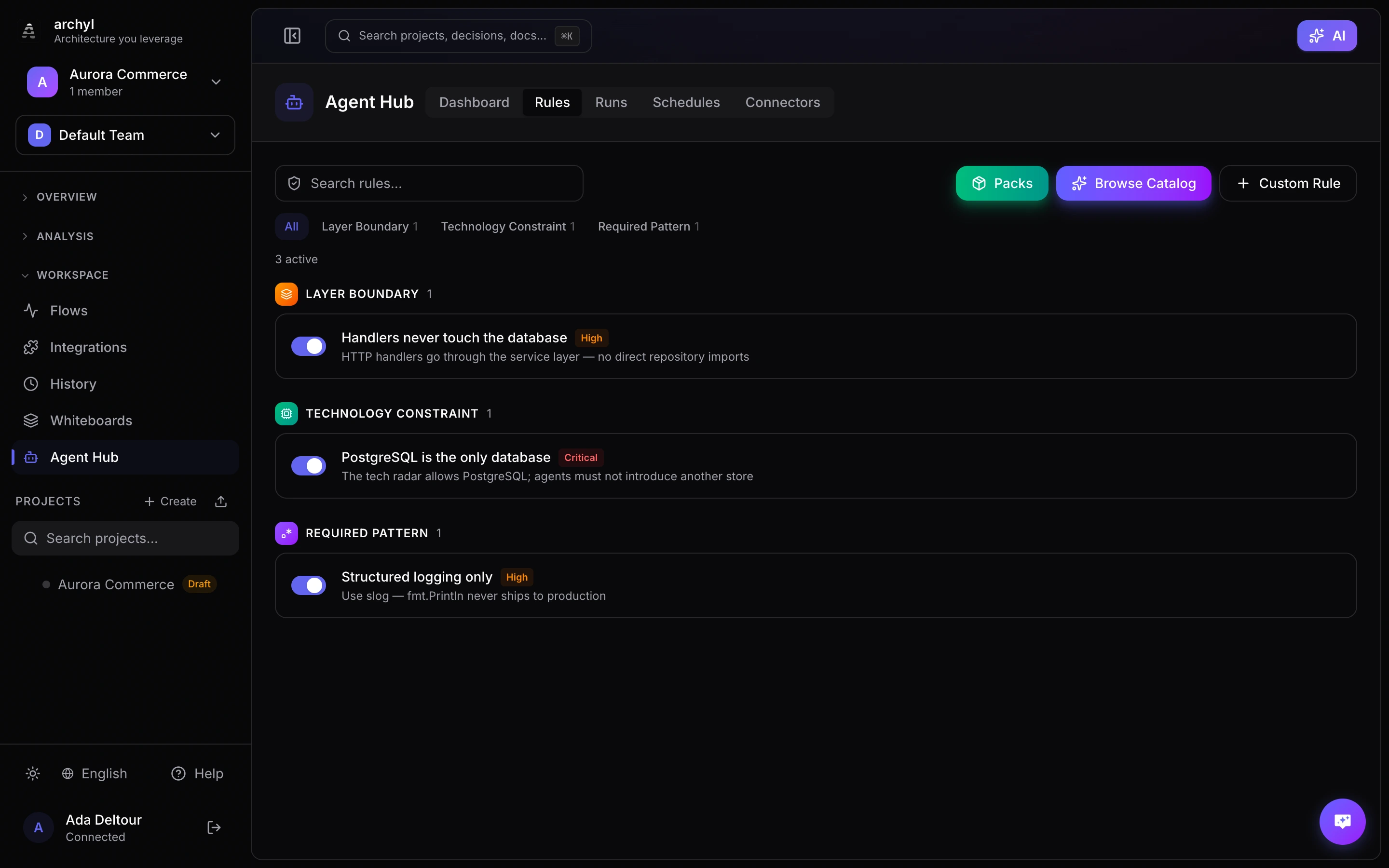
Rule packs are curated collections of conformance rules that encode best practices for common architecture patterns. Instead of writing rules from scratch, install a pack and get an opinionated, battle-tested ruleset in seconds.
Why Rule Packs?
Most teams follow well-known patterns — microservices, clean architecture, event-driven systems. Each pattern comes with constraints that should be enforced automatically:
- Microservices shouldn't share databases
- Domain layers shouldn't import infrastructure code
- Events should follow a schema contract
Rule packs turn these principles into executable guardrails.
Available Packs
| Pack | Rules | Focus |
|---|---|---|
| Microservices | 10 | Service boundaries, independent deployability, bounded communication |
| Clean Architecture | 9 | Layer boundaries, domain isolation, port/adapter enforcement |
| Event-Driven | 8 | Channel compliance, schema requirements, dead letter queues |
| API-First | 8 | Contract requirements, versioning, auth documentation |
| Security Baseline | 8 | Gateway enforcement, secret management, external access controls |
Installing a Pack
Via the archyl-developer skill
Ask your AI coding agent:
Install the microservices conformance rules pack
The agent calls the Archyl MCP server and creates all rules in one operation.
Via the SDK
import { ArchylClient } from "@archyl/sdk";

const client = new ArchylClient({
  apiKey: process.env.ARCHYL_API_KEY,
  organizationId: "your-org-id",
});

// Install a pack by name
await client.governance.installPack("microservices");
Via the UI
Navigate to Agent Hub > Packs and click Install on any pack.
What's in Each Pack
Microservices (10 rules)
- No shared databases — Each service must own its data. Cross-service queries via APIs only.
- Independent deployability — No compile-time dependencies between services. Shared libraries must be versioned.
- Bounded communication — Services communicate through defined API contracts or event channels, not direct database access or file sharing.
- Service isolation — No cross-service imports. Each service has its own dependency tree.
Clean Architecture (9 rules)
- Domain layer purity — Domain code has zero external imports. No framework, no ORM, no HTTP.
- Dependency direction — Dependencies point inward. Handlers depend on services, services depend on domain, never the reverse.
- Port/adapter enforcement — Infrastructure concerns (DB, HTTP, messaging) live in adapter packages, not in domain or service layers.
- Interface boundaries — Services consume interfaces (ports), not concrete implementations.
Event-Driven (8 rules)
- Channel compliance — Event producers and consumers must use declared event channels. No ad-hoc topic creation.
- Schema requirements — Every event must have a defined schema. No untyped payloads.
- Dead letter queue — Consumers must configure a DLQ for failed message handling.
- Topic naming conventions — Topics follow a consistent naming pattern (e.g.,
domain.entity.event).
API-First (8 rules)
- Contract required — Every public endpoint must have an OpenAPI, gRPC, or AsyncAPI contract on file.
- Versioning — API endpoints must include a version prefix (
/v1/,/v2/). - Auth documentation — Security schemes must be documented in the contract.
- No undocumented endpoints — Handler files without corresponding contract documentation trigger a violation.
Security Baseline (8 rules)
- Gateway enforcement — External traffic must route through an API gateway or load balancer. No direct service exposure.
- Secret management — No hardcoded secrets, API keys, or passwords in source code. Use environment variables or a secret manager.
- External access controls — Services that accept external requests must enforce authentication and rate limiting.
- TLS required — All inter-service communication must use TLS. No plaintext HTTP between services.
Customizing Rules
After installing a pack, every rule is fully editable:
- Change severity — Downgrade a rule from
criticaltomediumif it doesn't match your risk tolerance - Disable specific rules — Toggle off individual rules you don't need without removing the entire pack
- Modify configuration — Adjust file globs, patterns, allowed imports, or layer definitions to fit your project structure
Navigate to Agent Hub and click the edit icon on any rule to modify it.
Combining Packs
Packs are additive. Install multiple packs to cover different architectural concerns:
| Combination | Use case |
|---|---|
| Microservices + API-First + Security Baseline | API-driven microservice platform with security guardrails |
| Clean Architecture + Security Baseline | Monolith with strict layer boundaries and security hygiene |
| Event-Driven + Microservices | Event-sourced microservice system |
| API-First + Clean Architecture | Contract-driven monolith or modular monolith |
If two packs contain overlapping rules, Archyl deduplicates them — no conflicts.
Contributing
Rule packs are open source. You can propose new packs, add rules to existing ones, or report issues:
Next Steps
- Conformance Rules - Full guide to rule types and configuration
- GitHub Actions - Run conformance checks in CI/CD